CS1: Building a Design Function | CS2: Designing Out the Designer
case study two
"The goal was never to be indispensable. It was to make good design accessible."
Building a Self-Serve Creative Infrastructure
Company: Crown Agents Bank · Wholesale bank · Cross-border payments · Global markets.
Role: Lead design
Duration: August 2019 – June 2026. 7 years.
Type: Design strategy · Systems design · Operational design · Change management
.
- 70%: reduction in design requests due to self-serve
- 30%: reduction in turnaround time due to design system
- 5: Global locations operating from one design system
- 3: Asset categories consolidated into unified file systems (PowerPoint, Brochures, social media)
- Improved first-draft approval rate
- Reduced compliance approval time
The problem
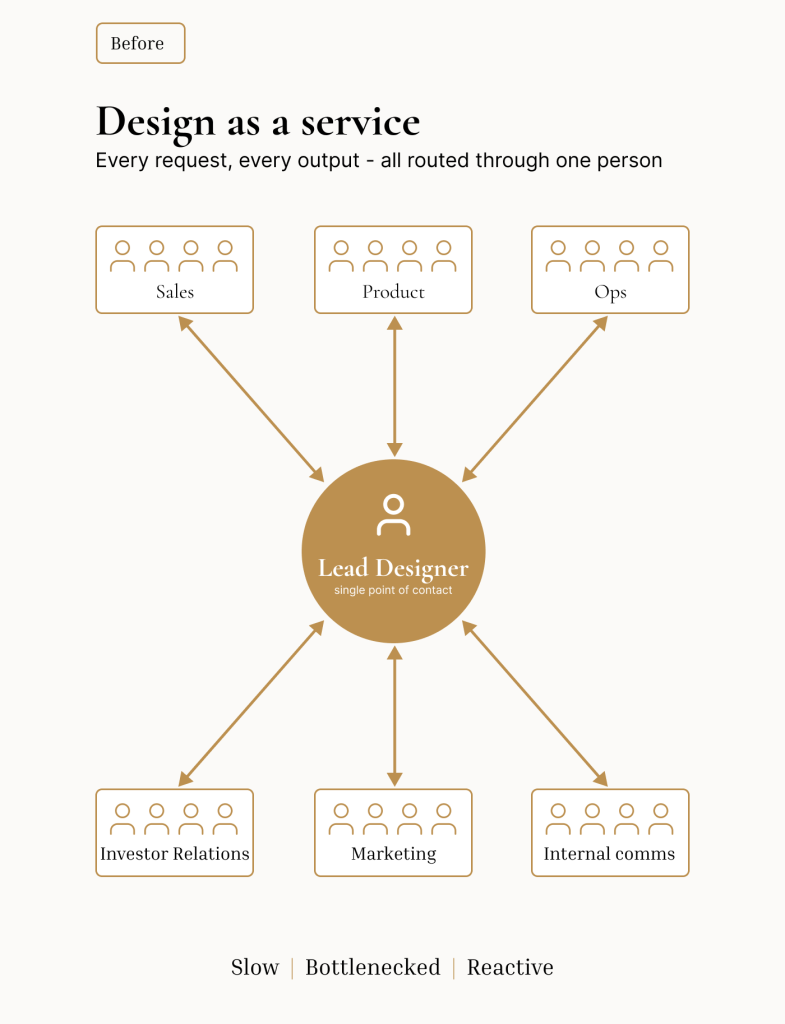
A sole designer serving a growing, globally distributed bank creates a structural problem that most in-house designers don’t name clearly enough: every creative request — no matter how small — funnels through one person. The designer becomes a bottleneck. Speed suffers. Quality is inconsistent when teams work around the designer. And the designer, consumed by routine production, has no time to think strategically.
This is the trap most in-house designers fall into: the better they are at execution, the more execution is demanded from them — and the less space there is for the work that actually moves the business forward.
I recognised this pattern early. And I decided to strategize my way out of it.
The insight
The question I started asking wasn’t “how do I produce things faster?” It was “how do I make it so I’m needed less?”
The distinction matters. Faster production still keeps the designer at the centre. Removing the designer from routine production frees them for the work that genuinely requires strategic and creative leadership, the brand decisions, the senior stakeholder work, the complex briefs, the thinking that a system can’t do.
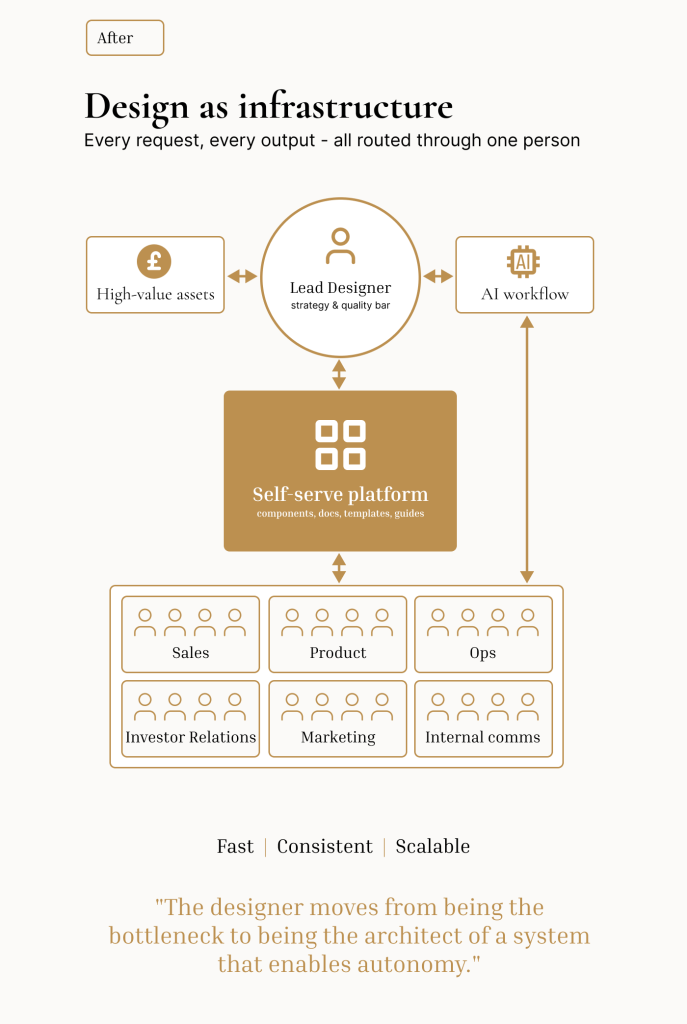
The goal was a deliberate shift in model: from design as a service, where everything flows through the designer, to design as infrastructure, where the designer builds the system, others operate it confidently, and the designer focuses on quality, strategy, and the work that only they can do.
This wasn’t a passive evolution. It was a planned strategic shift, and it required as much change management as it did design.
What I built
01 A scalable template suite
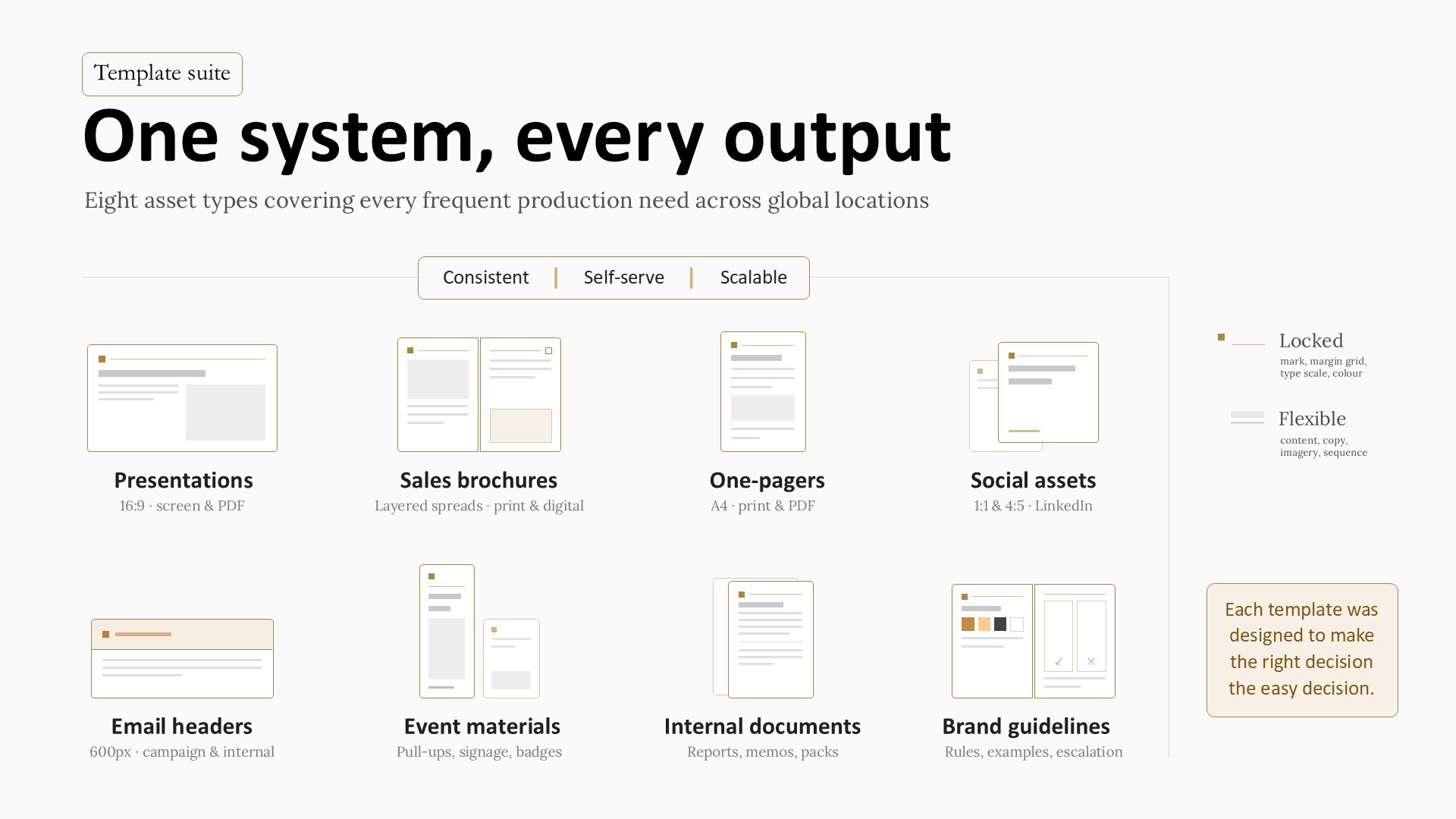
I designed and built a comprehensive template library covering the most frequent production needs across the business — presentations, one-pagers, social assets, email headers, event materials, and internal documents, across digital and print formats.
The constraint wasn’t technical — it was behavioural. Templates fail when they’re either too rigid (people work around them) or too open (people break them without realising). I spent as much time thinking about where to allow flexibility as where to enforce consistency. Each template was structured so the correct decisions were locked in and the creative options available within the system were all acceptable ones.
The sales brochure system illustrates this precisely. Rather than producing multiple separate documents for different sectors and audiences, I built a single layered file — one artboard per page, arranged in spreads, with layers that could be swapped to adjust content and branding for specific teams or markets. Digital and print outputs were managed from the same master. The system was adopted immediately and generated requests for bespoke versions from multiple sales teams — not because it was imposed, but because it was genuinely easier than the alternative.
Result: production turnaround reduced by approximately 30% across four global locations.
02 A social asset system built for consistency and evolution
Before the system existed, new social assets were created ad hoc — each one referencing only the most recent similar piece, saved in scattered individual files. There was no mechanism for learning from what had worked or building on successful creative directions.
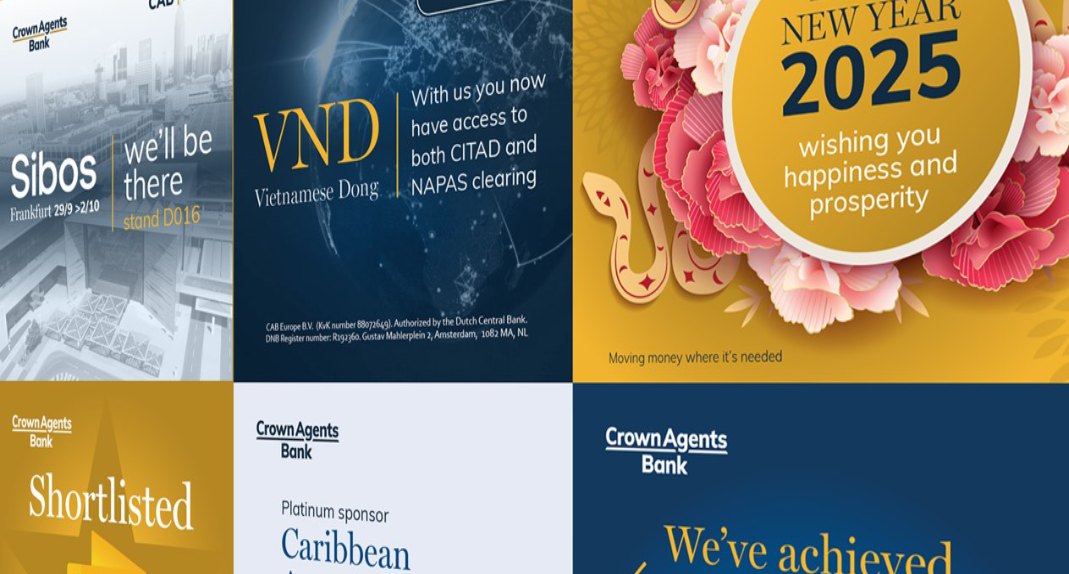
I consolidated the entire social output — LinkedIn graphics across all campaigns, all art directions, all evolutions — into a single structured file. The immediate effect was that locating, adapting, and evolving designs became dramatically faster. The longer-term effect was a visual identity for the bank’s social presence that evolved coherently rather than drifting.
The before/after is visible in the portfolio. The agency-produced 2022 output and the 2026 system I built tell the story without annotation: one is generic fintech, one is distinctly Crown Agents Bank.
03 Brand governance documentation non-designers could use
Most brand guidelines are written for designers. I wrote ours for the people who would actually use them: marketing managers, sales teams, regional offices working across time zones without design support, PAs producing internal communications.
This meant plain language with real examples, rather than abstract principles. Decision trees for common scenarios. And a clear escalation path: here’s what you can produce using the system, here’s when you need to brief the design team, here’s when you need specialist input.
Guidelines that get used are guidelines written for the reader, not the writer.
04 A structured briefing process
One of the largest sources of wasted time in any design function is poor brief quality. A vague brief produces vague work, or requires multiple rounds of iteration that eat time on both sides — and frustrate both parties in the process.
I designed and introduced a structured briefing template that asked the right questions upfront: objective, audience, channel, constraints, deadline, approval chain. The effect was measurable: briefs came in better, first-draft approval rates improved, and the time between brief and final delivery shortened significantly.
05 A curated external network with built-in quality standards
Scaling the design function beyond what in-house capacity could cover required a reliable external network. I built and managed a roster of freelancers and specialist agencies, developed onboarding materials that gave external partners everything they needed to work to CAB brand standards from day one, and established review processes that maintained quality.
This meant the design function could flex to meet demand peaks; campaign launches, product releases, new market expansions; without compromising output or overwhelming the in-house team.
THE SHIFT IN PRACTICE
Before this infrastructure existed, the ratio of my time was roughly 80% production to 20% strategy and direction. The work coming in was constant, the briefs were often underspecified, and the output — though high quality — was dependent entirely on my direct involvement in every piece.
After: routine production moved to the template system and the extended team. My time shifted toward brand strategy, senior stakeholder work, complex creative direction, and the thinking that a system genuinely can’t do. I moved from being inside the work to being above it — setting the standard, not repeatedly meeting it.
This is what design leadership actually looks like. Not doing everything, but building the conditions in which everything gets done well — and continues to get done well after you’ve moved on to the next challenge.
Reflection
impact at a glance
- 70%: reduction in design requests due to self-serve
- 30%: reduction in turnaround time due to design system
- 5: Global locations operating from one design system
- 3: Asset categories consolidated into unified file systems (PowerPoint, Brochures, social media)
- Improved first-draft approval rate
- Reduced compliance approval time
CS1: Building a Design Function | CS2: Designing Out the Designer